Thursday, October 31, 2019

Feathered Friends and France

As one of our coldest Halloweens on record comes to a close, I thought I would write a few lines as I wait for the final trick-or-treaters to come by. Last week marked the last of my fall meetings, and it was one that brought me "across the pond" to France. As I have already shared in some of my posts, these long flights provide a great opportunity for some stitching. 
October also marks the start of the Wooly Block Adventure. Participating shops design an 8-inch block based around a given theme. This year's theme is Holiday Celebrations. As you might imagine, shops are featuring holidays and seasons throughout the year. I find myself rather partial to patterns featuring fall themes. When I saw this pattern from Piecemaker's Quilt Shop in Hackensack, Minnesota, I promptly ordered it.
Although I missed the opportunity to document the process of tracing and fusing, here are a few tools of the trade that I thought I would share. There really aren't hard and fast rules about what thread and what stitches to use. The main thing is that you secure your pieces down. Depending on your overall goal, you can use either matching threads or ones that bring some contrast. As you can see from my picture above, I used a combination of both. The larger pieces are stitched to the background using a blanket stitch and matching colors. The leaves feature an outline stitch in a contrasting color. 
The picture below shows the different colors and types of thread that I used. For the most part, I use Valdani size 12 thread. As nice as these threads are, they are also a bit expensive. If I'm just needing a small amount of a given color, I most likely won't head to a quilt shop that sells Valdani thread. Rather, I will go to my stash of cross-stitching floss, pick the color I want, and use two strands of it for my stitching. Depending on the color and tones of the wool I am using, I may opt for an overdyed thread to add a little interest.

The tool in the picture below is a must for anyone with midlife eyes who needs some extra light for close work on an airplane. This is actually a necklace with an LED light that supports enhanced lighting to allow one to pass those long hours on an overseas flight with some stitching. Those overhead lights are nice, but they just don't cut it in the overall low lighting environment. This little device costs about $35 and is well worth it. I like to think of it as a quality of life intervention.
Although I had previously been to Europe on several occasions, I hadn't been to France. The international meeting I typically attend each fall was being held in Lyon, France, and I was fortunate to share some of my research at this meeting. An added bonus was bringing my daughter along. She had studied French in high school and was eager for her first trip to Europe.
Please rest assured that we were fully engaged in the meeting and attended our sessions. Here are a few highlights from our free time and adventures in Lyon. Lyon actually dates back to Roman times. It sits at the convergence of the Rhone and Saone rivers and was founded about 34 BC. One of the "must see" places in Lyon is the ruins of the Roman era theater. What you are seeing below is a picture of the "stage" of one of the theaters. The marble work was very impressive. Each of the different colors was imported from a different part of the known world including Greece, Turkey, Tunisia, Egypt, and Italy.
The precision of the original work is still very much intact.


Here is a view of another portion of the theater to give you a sense of its size.

Now for a more "modern" structure in the city. The following picture is of the St. John the Baptist Cathedral. Construction began in 1180 on the ruins of a 6th century church. It was not fully completed until 1476. It was absolutely gorgeous. On our final evening in Lyon, we had our dinner at a cafe just to the left of this picture. It was quite an ending to an amazing week.

One of the most iconic structures in Lyon is the Basilica Notre Dame de Fourviere. It is even more "modern," having been built in the late 1800s over about 12 years. It sits on the hillside overlooking the Saone and is actually only a short walk from the Roman theater. Here is what it looks like as you approach it from below.
And here is a front view once you make it to the top. We took the cable car given how steep the walk would be.
Finally, here was our final nighttime view of the basilica as we concluded our dinner by the cathedral. Unfortunately, the picture really doesn't do it justice.
 So, here we sit a few hours away from November. It's been quite a great year with many new adventures. Through them all, God has been faithful. I will close out this post with a verse from my last evening's devotion. It was a great reminder of God's sustaining faithfulness.
Do you not know? Have you not heard?
The Everlasting God, The LORD, the Creator of the ends of the earth
Does not become weary or tired.
His understanding is inscrutable. Isaiah 40:28

Saturday, October 5, 2019

Potato Leek Soup … with Sausage

2019 has definitely not been my year for regular blog posts. I've still been quite busy cooking and even finding some time for sewing projects. The majority of my writing, by necessity, has been scientific in nature. While I don't regret those efforts, I'm also feeling glad for a slight respite to share a blog post.
As those of you who read these posts probably know, fall is probably our favorite season and also one that finds us turning much of our garden produce into soup. This year has been no exception. This weekend found us pulling all of our leeks and converting them into not just one, but three different kinds of soup. I few years ago, I wrote about a good old stand-by potato leek soup. We jazzed it up with some bacon this year. After all, who doesn't like bacon?
This post will feature another variation on potato leek soup. This time, one with sausage and carrots. You can certain cut the recipe in half for a more manageable amount. We tend to approach soup-making with a "go big or go home" approach. This attitude does tend to keep our freezer full and help cut down on the mid-week cooking. 
Before I get into the recipe, here's my approach for cutting leeks. You will first notice that my garden leeks are a fair bit smaller than the ones you will find in the store. You can see the actual portion of the leek that I include after cutting off the roots and most of the green leaves. I then cut the remaining portion into about 1/2 to 1 inch segments. I then cut each segment lengthwise into fourths. Depending on how wide the white bulb is, I may cut it down a little more.

Here's the ingredients and steps for making this very warm and filling fall soup.
Ingredients
2 lbs Italian sausage; for this recipe, we prefer mild because the objective isn't to create a spicy soup but rather one that is full of flavor
2 tbsp olive oil
2 pounds of chopped leeks
4 medium carrots, or more depending on your preferences
4 minced garlic cloves
4-5 quarts chicken broth
2 lbs Yukon gold potatoes
2 bay leaves
3-4 sprigs of fresh thyme
salt and pepper to taste
1 cup heavy cream

Directions:
1. Brown the sausage in the bottom of the pot you will be using to make the soup. After the sausage is browned, spoon it into a bowl for later, leaving the drippings behind in the pot.
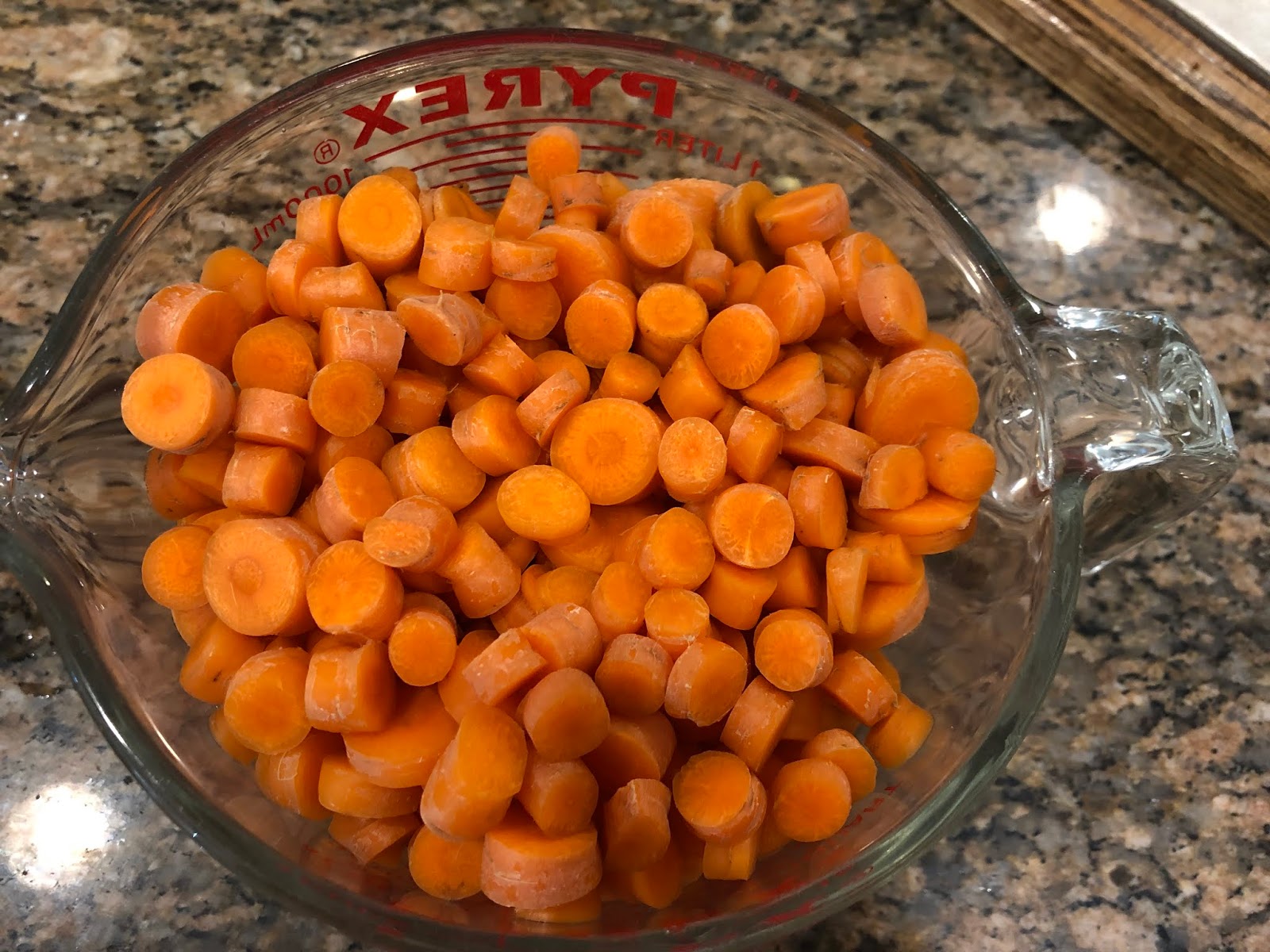
2. Add the olive oil, leeks, and carrots to the pot and saute them until softened, about 5-7 minutes. As you can see from the pictures below, I ended up with about 6 cups of chopped leeks and 4+ cups of chopped carrots. The carrots were also from the garden, and I was glad for the chance to use some them up. After you saute the vegetables, stir in the garlic and cook for another 1-2 minutes.


3. Add the broth - start with about 3 quarts, potatoes, bay leaves, thyme, and some salt and pepper. Boil until the potatoes are fork tender and the carrots are cooked through - about 20 minutes. Here's the size I cut my potatoes. I wasn't going for larger stew-sized pieces but rather what would fit on a spoon.
4. Add any additional broth as desired. We did end up using 5 quarts total. Stir in the sausage and the cream. Heat until the soup comes to a slight simmer and then turn the heat off. 
5. Serve with some nice warm bread and enjoy.

Monday, June 24, 2019

Curried Chicken Salad

For us, summer time means salad time. As we move towards July and temperatures that near 90 degrees, we lean towards cold dinners that don't require heating up the house. A few weeks ago, we tried our hand at making curried chicken salad. We were quite pleased with the results, and I am happy to share our recipe with you. Here's a little background on the rationale for this post …
My husband and I recently returned from a cruise of the Baltics. I anticipate you will be hearing more of that adventure in future posts. One of my favorite afternoon activities on board was going to afternoon tea. Among our sandwich options was one with curried chicken salad. It was actually quite good so I looked for a recipe after we came home. Here is how we put ours together:

Curried Chicken Salad
1.5 to 2 boneless, skinless chicken breasts
Olive oil
Salt & pepper
2 tablespoons mango chutney
1.5 tablespoons curry powder
1/2 cup diced celery
1 or 2 chopped green onions - use the white and green parts
1/4 cup dried cranberries (you can substitute raisins or even omit)
1/2 cup cashews
3/4 cup mayonnaise

1. Place the chicken breasts on a sheet pan. Brush with olive oil and sprinkle with salt and pepper. Roast in a 350 degree oven for about 35 to 40 minutes until the chicken is cooked through. Allow to cool and cut into bite-sized pieces. Here is what ours looked like.
2. Stir together the chutney, curry powder, celery, onions, dried cranberries, and cashews in a medium sized mixing bowl. Your mixture will look something like this.
3. Now, stir in the chicken and combine
4. Stir in enough mayonnaise to moisten everything and reach the desired consistency. To be honest, I didn't actually measure the mayonnaise. I just scooped out what looked like the right amount and stirred it in.
5. Serve on the bread of your choice. We opted for croissants. A honey wheat bread would also be good. 
Stay cool and enjoy your summer!

Sunday, March 31, 2019

Warm wooly blocks for cold winter days

Although we have officially passed the first day of Spring, we've continued to see some off and on snowstorms. Just two days ago, we had a storm that resulted in several inches of wet, heavy snow. Today, however, the sun is shining, and the day looks more like the last day of March. Here are a few images from my around back yard during the past week.


Before we turn the calendar page to April, I thought it might be fun to share some of my warm and wooly creations from this past winter. Some of my past posts have featured some of my Row by Row creations. The group that sponsors the Row by Row event of the summer also sponsors a Wooly Block Adventure event in the fall. Because fewer shops participate in this event, the sponsors spotlight patterns from two or three shops on their website every other day. "Woolies," as they like to call their followers, can download these patterns for free during this spotlight period. Most participating shops also offer kits of their patterns for sale during this fall event as well. 
To get to the point of this story, I followed along during October and November when the patterns were featured. In the spirit of true confession, I also did my fair share of ordering kits. This meant that I also had plenty of explaining to do as multiple packages were arriving in the mail (well, not really that much). At the same time, it was rather fun to come home and find packages waiting on the kitchen counter for me.
During the past 5 months, I've had two trips to Asia. Wool projects travel very well and are a great way to pass the time on these long extended trips. I also need to take care to discipline myself to use stitching time as a reward for completing other work-related tasks first.
Here are a few of the blocks. Not all are fully complete with the added embellishments. Just the same, I thought they would be fun to showcase.
These sunflowers are from The Quilter's Lodge in Draper, Utah. This is a delightful shop with rooms that can be used for a quilting retreat. 
This little hummingbird is from Piecemakers Quilt Shop in Hackensack, Minnesota. The flowers in this block reminded me of our hanging baskets from last summer that attracted several hummingbirds.
I purchased this block kit in honor of my daughter who is quite a fan of bees. This block is from Danner's Bernina Shop in Hanover, Pennsylvania.
As I have mentioned in several other posts, I love sheep. This block is from Calico Patch Designs in Morehead, Kentucky. 
The chickadee block featured at the top of this post is from Primitive Gatherings in Racine, Wisconsin. We enjoyed watching a number of chickadees at our bird feeder this past winter.

Just as we are coming out of a literal season of winter, I also seem to be coming out of a bit of a figurative season of winter with some of my work projects. I've needed to remind myself that just as the literal seasons do not last forever so also these figurative seasons do not last forever. These verses from Isaiah remind us of God's faithfulness to accomplish his purposes.

"Remember the former things long past,
For I am God, and there is no other;
I am God, and there is no one like Me,
Declaring the end from the beginning,
And from ancient times things which have not been done,
Saying, 'My purpose will be established,
And I will accomplish all My good pleasure';
Calling a bird of prey from the east,
The man of my purpose from a far country.
Truly I have spoken; truly I will bring it to pass.
I have planned it, surely I will do it.
Isaiah 46:9-11

Sunday, February 3, 2019

A Down Home Super Bowl Spread (featuring spicy black eyed peas)

To be rather honest, I'm really not that much of a fan of professional football. I'd much rather enjoy a college football game, specifically one involving the University of Utah. That being said, I'm always up for an opportunity to create food around a given theme. A few years back, when the Ravens were playing, we created an Edgar Allan Poe-themed dinner, complete with hot raven wings and a pit of queso dip. (Feel free to call us odd.) Last year, we made Swedish meatballs in honor of the game's being played in Minnesota.
With the 2019 game being played in Atlanta, it gave us the opportunity to pursue some good down home cooking. Given that I was hosting an early afternoon after church meeting at my house, I was doubly delighted to share some of this cooking with others. 
The inspiration for this year's Super Bowl dinner was Mrs. Wilkes Dining Room in Savannah, Georgia. If you ever happen to find yourself in Savannah, I can't recommend this spot highly enough. We had the wonderful good fortune of having lunch there this past September when we were in Savannah for a meeting. Mrs. Wilkes Dining Room is a former boarding house that is now one of the most popular places for lunch in Savannah. It is open from 11:00 am - 2:00 pm Monday through Friday. People start lining up well before 10:00 am. I'm thinking we were there by about 9:30 am, and I don't begrudge the wait. Guests are seated family style around large tables loaded with amazing Southern style home-cooked food.


We did pick up a cookbook featuring some of Mrs. Wilkes recipes. I will be sharing our interpretation of her recipe for black eyed peas and rice.

As I've shared before, black eyed peas really aren't peas but a type of bean. In the South, they are traditionally served on New Year's Day for good luck, but they are quite good any time of the year. We have a soup that we like to make with our leftover Easter ham that features black eyed peas. To be fair, though, black eyed peas do have a distinctive taste that either resonates with people or not. We've come to enjoy recipes with black eyed peas so here is how we made today's dish.
Ingredients:
1 pound dry black eyed peas
1 pound sausage, browned (we picked a mild sausage, but feel free to use a spicy sausage if that is what you like)
1 cup chopped onion
1/2 green pepper, chopped
1 cup uncooked rice, we used parboiled rice (I will explain more later)
Salt and pepper to taste
Additional seasonings to taste

Directions:
1. Soak the peas using either a hot soak or cold soak overnight. There really isn't a clear advantage of one technique over another. Depends on your time availability and preference.
2. Drain the beans, cover them with water so that the water is at least an inch over the top of the beans. Boil until almost tender. We had used a hot soak and then let the beans simmer for about 1 hour to get to the "almost tender" stage.
3. While the beans are simmering, brown the sausage. After the sausage is browned, remove from heat and stir in the onion and pepper. Let this combination set while you are waiting for the peas to get to the "almost tender" stage.
4. After the beans have reached the "almost tender" stage, stir in the sausage, onion, and pepper mixture along with the rice. We have found that parboiled rice holds up better and doesn't disintegrate the way a traditional long grain white rice will. It's really your call what type of rice you use.
5. Simmer all ingredients together for about another half hour. Turn off the heat and stir.
6. Season up as you choose. In addition to the salt & pepper, we used a little Slap Ya Mama seasoning. Feel free to use Tabasco sauce or whatever you might prefer to spice up your black eyed peas.

In case you are wondering what else was on the menu, you could see the smoked pulled pork. I also included some green beans with a bit of onion and bacon. We also included some stewed tomatoes with okra and bacon as well as two types of cornbread muffins. I made the first batch using a traditional Southern recipe with a greater proportion of cornmeal to flour and no sugar. My husband said, "well, they're rather dry," so I made another Yankee-style batch with sugar and a greater proportion of flour to cornmeal. Just the same, I mixed them up in the breadbasket and let people see if they could decide which was which.
I just learned that it is now halftime (I honestly haven't been watching the game). Given that rams are of the genus ovis, as are sheep, and I quite like sheep, I will cheer for the Rams. (I did mention earlier, that I am odd.) Regardless of who wins, I hope that you have had a great day in the company of good friends and had the chance to enjoy good food.

Thursday, January 31, 2019

Welcome to 2019

Here we find ourselves at the close of the first month of 2019. Even though I do enjoy the excitement and anticipation of the start of a new year, January is a month that seems to linger on forever. For this post, I thought I would share a few of the stitching projects that I use to occupy my time during this long and dark month.
I've shared in several earlier posts that Shepherd's Bush is my favorite stitching shop. Having it so close to home is rather convenient, and I don't have any trouble leaving the shop a little greener than I found it. Each New Year's Day, the shop is open for a few hours for a 10% off sale. Each New Year's Day, they also introduce a new scissors fob or, as I like to think of it, a small ornament. I'm not quite sure when the shop introduced these stitching projects. The oldest one I have dates back to 2003, and I think I have one for every year since then. At any rate, I enjoy having a new small stitching project to start the new year.
Now time for a bit of a confession …
Last year, I did the stitching work, but never got around to actually finishing the ornament. During the holiday weekend a couple of weeks ago, I determined to finish the stitching on my 2019 ornament and then to complete the stuffing and finishing work for both. Here's a look at the finished squares ready to be sewn together and then stuffed. You can see that each ornament will have both a front and a back with a cross stitched design.
Now for a closer look at the finished projects. First the mermaid from 2018 …

And then this year's sheep … I continue to find it hard to resist a stitching project that features sheep.

 For fun, here are some looks back at projects from past years …

So, what exactly might one do with these small projects? Good question. I'm one who likes to have something to brighten up the house after I take all of the Christmas decorations down. I have a 6-foot alpine tree that I keep upstairs in my living room all year round and change its decorations out with the seasons. During January and February, I have it decorated with some icicle garland and these little New Year pillow ornaments.
My children tend to find this practice of mine a little odd, but I keep it up each year just the same. We will see just how many more small ornaments this tree can hold. For now, I am going to wish you blessings for the remainder of this new year. Even though getting through January seems to be an exercise in endurance, the anticipation of what God will do in 2019 still brings an eagerness. As the psalmist reminds us …
Wait for the LORD,
Be strong and let your heart take courage;
Yes, wait for the LORD. Psalm 27:14

Wednesday, January 30, 2019

Schnitzel with Noodles


I realize it's been quite a while since I've made a post. Here's a little snapshot of our cooking adventures from about a week and a half ago. We initially intended to participate in a German-themed event, complete with authentic German food. To make a long story short, we weren't exactly thrilled with the changes in the menu for this year so we opted to prepare our own German dinner. As you can see by the picture of what is simmering away on the stove, we prepared schnitzel, spaetzle, and red cabbage. When all was said and done, the red cabbage was really the only thing we prepared from scratch, but the dinner was still pretty good.
You might be asking, just what are schnitzel and spaetzle? Good question. Here's a little background before I go on to describe how we prepared them.
Schnitzel, or "slice," of meat originated in Austria. Wiener schnitzel actually has nothing to do with the hot dog chain. "Wien" is the city that we, in America, refer to as Vienna. Traditional Wiener schnitzel is made from veal pounded flat and then coated in flour, egg, and bread crumbs before being fried. We weren't able to acquire any veal at our local grocery store, but we did find some pork that had already been prepared as schnitzel. As you can see from the picture below, the pounding and breading had already been done.
The schnitzel is then deep fried in about a quarter inch of cooking oil. 
So then, what is spaetzle? Glad you asked. Spaetzle is actually a German egg noodle. It is typically served with meat and gravy and is typical of the cuisine of southern Germany and Austria. While a number of different recipes for spaetzle are available, we typically just buy dry spaetzle and then boil it on the stove as we would any other type of pasta. This time, we also just made our gravy from a mix. 
As I mentioned above, we did make the red cabbage from scratch. You can find the recipe on an earlier post. Ours is prepared in the Danish style without the heavier spices that are typically part of the German red cabbage.
Here is everything all served up and ready to be enjoyed. Guten Appetit!